

How Does A Document Camera Work
Document cameras, besides known every bit visual presenters, visualizers, digital overheads, or docucams, are real-time image capture devices for displaying an object to a large audience. Similar an opaque projector, a document camera is able to magnify and project the images of actual, iii-dimensional objects, too as transparencies.[i] They are, in essence, high resolution web cams, mounted on arms so as to facilitate their placement over a page. This allows a teacher, lecturer or presenter to write on a canvass of paper or to display a two or three-dimensional object while the audience watches. Theoretically, all objects tin can be displayed by a document camera. Near objects are simply placed nether the camera. The camera takes the picture which in plough produces a live picture using a projector or monitor. Different types of document photographic camera/visualizer allow great flexibility in terms of placement of objects. Larger objects, for example, can simply be placed in front of the camera and the camera rotated as necessary,or a ceiling mounted document camera tin too be used to allow a larger working area to be used.
Uses [edit]
Typical
- Lecture hall or classroom utilize
- Presentation of material in conferences, meetings and training sessions
- Videoconferencing and telepresence
- Presentation of prove in courtrooms
- Diverse medical applications (telemedicine, telepathology, display of ten-rays)
Document cameras replaced epidiascopes and overhead projectors, which were formerly used for this purpose. By ways of the zoom feature a document camera can enlarge the small print in books and projection a printed folio as if it were a traditional transparency. Likewise, the room lighting does not have to be darkened to operate a document camera; in a classroom setting this is an asset.[ii] Most document cameras can also send a video bespeak to a computer via USB cable. Sometimes document cameras are connected to an interactive whiteboard instead of a standard screen.
Some document cameras can exist supplied with an accompaniment so that they tin can be used with a microscope.[ citation needed ]
Equally of 2016[update], camera sensors in document cameras are mostly providing either 720pHD (1280x720 pixels) or 1080pHD (1920x1080 pixels) native image resolution.
History [edit]

Video Lupe 1974, manufactured by Wolf Audio Visuals - document camera prototype model

Video Loop (Wolf Audio Visuals) AV installation c. 1975 - prototype document photographic camera
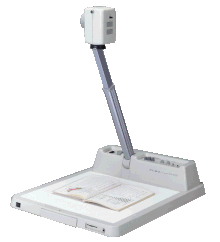
ELMO releases its commencement Visualiser EV-308
Document cameras were developed to meet an increased demand for the ability to projection and present original documents, plans, drawings and objects directly, rather than necessitating the prior preparation, that would be required for their apply as part of an overhead projector based presentation. The beginning Visualizer/certificate camera were developed by the companies WolfVision and Elmo and were launched at the photokina Merchandise Fair in 1988.[three] [4]
The widespread use of computers, projectors, and popular presentation programs such equally Microsoft PowerPoint in meeting rooms, meant that overhead projectors became less frequently used. Certificate cameras continue to provide a convenient and flexible style of allowing documents, books or slides to be spontaneously displayed during presentations as required.
The starting time attempts and prototypes were mostly simple video cameras on a copy stand. During the mid-1970s these were assembled and equipped with additional lighting to ensure that they were able to operate in darkened rooms, and also to provide a consequent quality of projected epitome. The applied science of video cameras during this time, was a key factor in the development of document camera systems. Certificate cameras have also ofttimes benefited from developments in other industries, which also facilitated significant advances in the field of document camera technology. A practiced example of this is the technology used in photographic equipment, which has contributed much to the development of the certificate camera as a high quality presentation tool.
At the end of the 1990s progressive scan cameras were introduced. Many visualizers bachelor on the market today are capable of at least 30 frames per 2d output, which ensures loftier quality imaging and smoothness of motility in all resolutions and attribute ratios.
Applied science [edit]
The blueprint and specification of a document photographic camera are a combination of several different technologies. The quality of the recorded image is dependent on the primary components, which are: eyes, camera, lighting organisation and motherboard with appropriate firmware (software). The finished production is and then realised past the product of different mechanical designs by individual manufacturers. Today High-Definition Document cameras are available with HDMI output, Sound/Video recording and playback is possible, and some High-Definition certificate cameras are as well using loftier-speed WIFI engineering to eliminate the demand for cables.
Optics [edit]
Optics are one of the most disquisitional components relating to image quality, and the quality of the optical system used will largely depend on the planned cost of the device. Simple or highly complex optical systems can be used, which tin can differ significantly in both quality and size. The iris or aperture is another important component of the eyes. The iris controls and regulates the corporeality of light that passes through the lens onto the epitome sensor. A lens will focus on exactly one point of an object to be imaged onto the sensor. However, at that place is too an area in forepart of and behind the point of focus that volition exist perceived as existence in sharp focus past the man center. This is chosen the depth of field, and it is dependent upon the size of the iris or discontinuity. (the smaller the aperture, the greater the depth of field).
Camera [edit]
Progressive scan cameras use either CCD sensors or CMOS sensors. The full general advantage of progressive scanning over the interlaced method is the much higher resolution that is the consequence. A progressive scan camera captures all scan lines at the aforementioned time, whereas an interlaced photographic camera uses alternating sets of lines.
Basically, image sensors provide only monochrome images. With a ane-bit camera, colour information tin can be easily obtained through the employ of colour filters over each pixel. With 1-flake cameras, the and so-called Bayer filter is very common. Red, dark-green and blue filters are bundled in a pattern. The number of greenish pixels is twice as large as that of the blue and ruddy, thus the higher sensitivity and resolution of the human eye is replicated. To get a colour paradigm, different algorithms are then used to interpolate the missing colour information.
A 3CCD photographic camera module is some other mode to produce color images. A prism is used to split white calorie-free into its reddish, dark-green and blue components and a separate sensor is then used for each colour. This complex photographic camera technology is used in iii-scrap cameras and allows for splendid color reproduction at very high resolutions.
Mod camera systems used in a certificate camera are able to provide high-resolution color images at 30 frames per 2nd. In a 3-chip camera, the measured resolution may be up to 1500 lines. In addition the image can be adjusted to fit common display aspect ratios of 4:3, 16:9 and 16:x.
Lighting system [edit]
Lighting is an essential function of a document photographic camera. To ensure good colour rendition, the lighting system used to illuminate the image capture area should exist as uniform as possible. The greater the calorie-free intensity, the more than contained the certificate camera is from ambient light sources. Using powerful lighting systems enables smaller apertures to be used, and this in plough provides a significant increase in the depth of field that can be achieved past the document camera. Also the college the quality of the light source, the more low-cal that will reach the camera sensor, and this results in less noticeable racket, and therefore the quality of image is not degraded.
Some document camera models integrate additional functionality into the light system, such equally a synchronized low-cal field that clearly indicates to the user at all times, by way of an illuminated image capture area or laser markers, the size and position of the imaging area, which adjusts simultaneously as the lens zooms in or out.
Motherboard and firmware [edit]
The motherboard plays an important role in epitome processing and it has a major influence on the quality of the eventual image that is produced. Larger and larger resolutions and high refresh rates generate large amounts of data that must be processed in real-time.
Document cameras have a wide diversity of sophisticated automated systems that are designed to make the user experience as easy every bit possible. Permanent autofocus detection, for example, automatically adjusts the focus settings when a new object is displayed, with no demand for user intervention. Other important features include automatic automobile iris, automobile exposure, auto white balance and automatic proceeds control.
A document camera needs an paradigm display device to bear witness the information to the audience. Mod motherboards have a multifariousness of connections to ensure flexibility of use. In addition to HDMI, DVI, VGA ports for connecting to displays, (projectors, monitors and video conferencing systems) there are also several interfaces provided to facilitate connection to a computer or interactive whiteboard. These interfaces are most commonly USB, Network (LAN) and serial.
In addition, an external PC or laptop tin exist connected to the certificate camera to allow for switching between a Power Point presentation and a live demonstration. Some models can also handle external storage devices and play files directly from a USB flash drive, or relieve images taken during the presentation onto it.
Some document camera manufacturers besides provide for regular firmware upgrades, allowing users to have the opportunity to be equipped with, and do good from new features as they go available.
Certificate camera types [edit]
Document cameras are generally divided into 3 groups. Smaller lightweight models are considered portable, larger sturdier and more than stable units are known equally desktop models, and the third grouping are ceiling visualizers. These are designed to be ceiling mounted above a tabletop or podium.
Portable and desktop models [edit]
Portable and desktop models let a similar working environment to that of an overhead projector. Many document camera users appreciate the added flexibility in terms of the variety of objects that can be displayed to an audience. Portable devices can be used in multiple locations without requiring whatever prior special installation.
Ceiling models [edit]
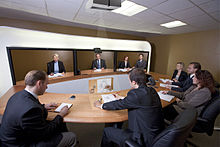
Ceiling Visualizer in use in a typical Telepresence installation
Ceiling-mounted certificate cameras/visualizers are a variation from the traditional desktop models and allow for larger objects to be displayed. At that place is no desktop technical equipment to restrict the views of speaker and audience, every bit the applied science is installed unobtrusively in the ceiling. Ceiling models are often used to support videoconferencing or telepresence systems to further enhance the immersive feel for participants.
References [edit]
- ^ Everhart, N. (2000), "Big", School Library Journal, 46 (six) .
- ^ Everhart, N. (2000), "Big", Schoolhouse Library Periodical, 46 (6) .
- ^ "Presentation, Collaboration & Visualizer Systems".
- ^ "Visual Presenter with 8-Power Zoom Lens". New Applied science Nihon. Japan External Trade Organization, Machinery and Engineering science Dept. 16: 37. 1988. Retrieved 2014-04-21 .
Source: https://en.wikipedia.org/wiki/Document_camera
Posted by: cotecauseveras1987.blogspot.com
0 Response to "How Does A Document Camera Work"
Post a Comment